If you’ve ever stared at a cannabis label and wondered what the difference between THCA and THC actually means for your experience, you’re not alone. These two compounds are more connected than you might think — and understanding the relationship between them is the key to shopping smarter and feeling more confident about what you’re bringing home. Here’s the breakdown, no chemistry degree required.
Understanding The Core Difference
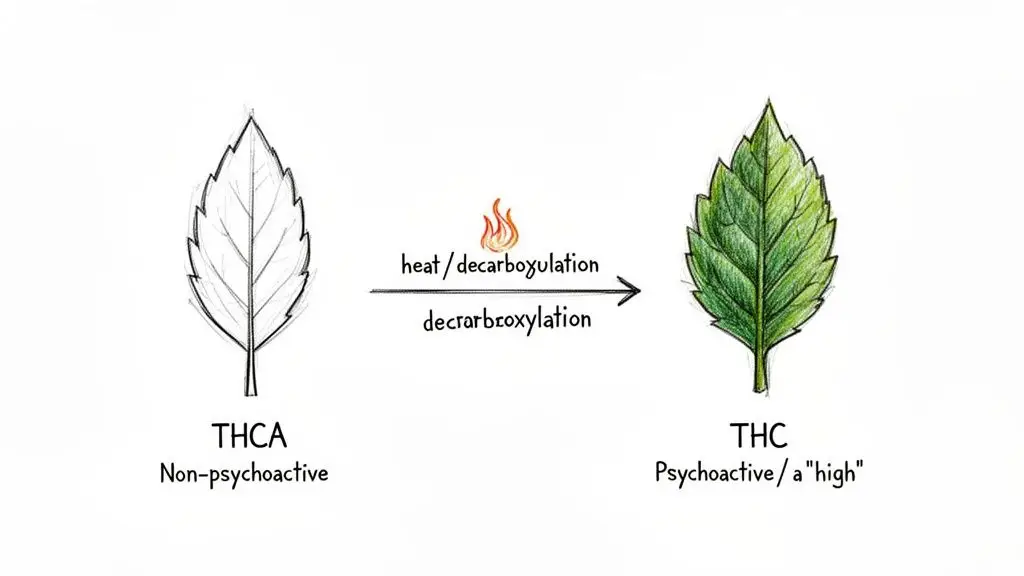
When you look at a fresh cannabis plant, its flowers and leaves are packed with Tetrahydrocannabinolic acid (THCA), not the psychoactive Delta-9-tetrahydrocannabinol (THC). This is a really important distinction for anyone enjoying cannabis.
On a molecular level, THCA has a different shape that keeps it from fitting into the body’s CB1 receptors in the brain. These are the very receptors that THC binds with to produce its well-known euphoric effects.
This means if you were to eat a raw cannabis bud or juice its leaves, you wouldn’t feel high. The THCA it contains just doesn’t have the right key to unlock the psychoactive feelings we associate with cannabis. The real change happens when you add a little heat.
The Role of Heat and Activation
The process that converts THCA into THC is called decarboxylation. It’s a science-y term that just means heat removes a carboxyl group from the THCA molecule, changing its shape into the psychoactive THC your body recognizes and can use.
This reaction is triggered whenever you light a pre-roll, use a vape, or bake your flower for edibles.
That’s why understanding the relationship between THCA and THC is so important when you visit a dispensary. The THCA percentage on a flower label at a place like BUZZY tells you its potential psychoactive strength once you heat it up.
To make the comparison super clear, here’s a quick breakdown of their main attributes.
THCA vs THC At-a-Glance Comparison
This table offers a snapshot of the core differences between the inactive precursor, THCA, and its activated counterpart, THC.
| Attribute | THCA (Tetrahydrocannabinolic Acid) | THC (Tetrahydrocannabinol) |
|---|---|---|
| Psychoactivity | Non-psychoactive (does not cause a ‘high’) | Psychoactive (causes a ‘high’) |
| Found In | Raw, unheated cannabis flower and leaves | Heated cannabis (smoked, vaped, baked) |
| Activation | Inactive precursor that requires heat | Activated compound ready for the body |
| Primary Use | Studied for wellness benefits without intoxication | Recreational and therapeutic psychoactive effects |
Getting a handle on this simple but vital difference is the first step toward making confident, informed choices about the cannabis products you buy and how you enjoy them.
The Science of Decarboxylation and Psychoactivity
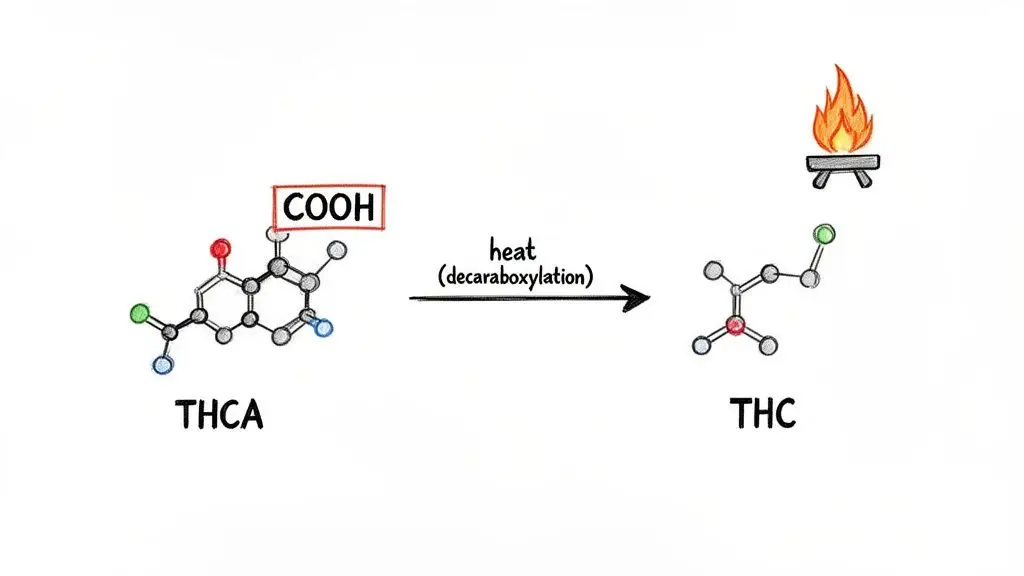
Here’s a fascinating bit of cannabis chemistry: that fresh, raw flower you see in the jar isn’t actually psychoactive on its own. It’s packed with THCA, the non-intoxicating precursor to THC. The magic that turns one into the other is a simple process called decarboxylation, and all it requires is heat.
It’s the scientific reason why smoking, vaping, or baking your cannabis unlocks its famous effects, but just eating a raw nug won’t do much of anything. Think of it as the secret handshake that gets the party started.
At a molecular level, decarboxylation knocks a carboxyl group (COOH) off the THCA molecule. That little group is like a bulky protective cover, preventing the molecule from fitting into the cannabinoid receptors in your brain—specifically, the CB1 receptors that produce a “high.”
When you apply heat from a lighter, a vape, or your oven, that carboxyl group breaks away as carbon dioxide and water. The molecule that’s left behind is the legendary Delta-9 THC, now perfectly shaped to create an effect. For a closer look at this famous cannabinoid, check out our guide on what Delta-9 THC is and how it works.
Why Molecular Shape Determines the Effect
This newly reshaped THC molecule is now the perfect key for the CB1 receptor’s lock. Once they bind, it kicks off the whole chain of neurological events we associate with feeling euphoric, relaxed, and creative. Without that heat-activated transformation, the THCA key simply doesn’t fit the lock.
And this isn’t just a loose theory—it’s proven science. The binding ability of THC is dramatically stronger than its raw, acidic form. Research has found that THC has a 62-fold greater affinity for CB1 receptors than THCA does. In simple terms, THC is wildly more effective at producing a high, while THCA on its own barely registers.
This is a game-changer for understanding cannabis labels in New York. When you see a high THCA percentage on flower from a brand like MFNY or Florette at a licensed shop like BUZZY, you’re looking at its psychoactive potential. The heat you apply is what makes that potential a reality.
Understanding this simple science empowers you to read product labels like a pro. It explains why different consumption methods give you completely different experiences and helps you appreciate the chemistry behind your cannabis. Decarboxylation isn’t just a technical term; it’s the bridge between the raw plant and its celebrated effects.
Comparing Effects and Potential Benefits
When it comes to THCA and THC, we’re talking about two completely different experiences. The best way to choose between them is to start with your intention: are you looking for a classic psychoactive journey or non-intoxicating wellness support?
Answering that question is the key to making the right choice at a licensed New York dispensary like BUZZY.
Most people know THC for its psychoactive effects. It binds with the brain’s CB1 receptors, creating that familiar spectrum of feelings—from euphoria and relaxation to heightened senses and creativity. Many of us reach for THC to help melt away stress, lift our mood, or just unwind at the end of a long day.
But that classic “high” isn’t for everyone, and it’s not always right for every situation. For some people, especially with higher doses, THC can bring on anxiety or paranoia. It’s why we always say to start low and go slow, especially if you’re trying a new product.
The THCA Experience: A World Apart
In total contrast, raw THCA is non-psychoactive. Its unique molecular shape keeps it from binding with those same CB1 receptors, meaning consuming it in its raw form won’t get you high.
This makes THCA a fascinating option for anyone focused purely on the plant’s potential wellness properties, without any intoxicating effects. It lets you explore the benefits of cannabinoids in a completely different way.
The core difference is simple: THC alters your state of mind, while THCA works behind the scenes without the high. This is the single most important factor when deciding which one fits your goals.
Potential Benefits Under Investigation
The science around THCA is new and exciting, and while it’s important to remember this is all still being studied, the initial research is promising. Scientists are exploring how THCA interacts with our bodies to support wellness.
Here are a few of the key areas being looked at:
- Anti-Inflammatory Properties: Some studies suggest THCA may help reduce inflammation, making it a point of interest for those dealing with chronic inflammatory issues.
- Neuroprotective Qualities: There’s early-stage research into whether THCA could help protect brain cells, hinting at potential support for neurodegenerative conditions.
- Anti-Nausea Effects: Just like THC, THCA has been studied for its potential to calm nausea and vomiting, which could be helpful for people undergoing difficult medical treatments.
Because of these potential benefits, you’ll often find THCA in products designed to keep it in its raw state, like unheated tinctures, raw cannabis juices, or topical creams. The separation is clear: intoxicating vs. non-intoxicating. And that’s your ultimate guide to finding the right product for you.
Navigating New York Cannabis Laws and Labels
Ever seen “THCA flower” sold online or in an unlicensed shop and wondered what the deal is? It can get confusing, but in New York’s regulated market, the rules are actually built for clarity and your safety.
Those other products often try to find a legal loophole in the federal Farm Bill, claiming they’re compliant because they contain less than 0.3% Delta-9 THC in their raw, unheated state. But that overlooks the most important part: the moment you light it up, that non-psychoactive THCA converts directly into THC. New York’s licensed market cuts right through that noise with a simple, honest standard.
Understanding “Total THC” on New York Labels
When you shop at a licensed dispensary like BUZZY (License #OCM-RETL-25-000285), every single product has been tested and is clearly marked with its “Total THC” content. This number isn’t just the Delta-9 THC that’s already there—it’s the full psychoactive potential you can expect once the product is heated.
This total value is calculated to show you exactly how much THC will be available after you smoke, vape, or cook with your flower. For you, it means what you see is what you get. A flower labeled with a high Total THC is going to deliver a potent experience, period.
This is the real difference between shopping in the regulated market versus taking a chance elsewhere. Licensed shops give you lab-verified data on the full cannabinoid content, so you’re never left guessing about a product’s true strength.
This isn’t a new idea, either. A 1981 study on fresh cannabis showed that this conversion was the key to understanding a plant’s potential. Fast forward to today, when you see a premium flower from a New York cultivator like Doobie Labs or Florette with 20% THCA on its lab report, you know it will convert to about 17.5% THC when you heat it, using the standard formula (THCA x 0.877).
Why Shopping Licensed Is Safer
This focus on Total THC isn’t just a labeling quirk; it’s a commitment to your safety and empowerment. When you shop at a licensed dispensary, you can trust that the numbers on the package accurately reflect the product’s real potential.
This transparency lets you make choices you can feel confident about and find the exact experience you’re looking for—no legal gray areas, no guesswork. It’s simply the safest, most reliable way to explore cannabis in New York.
How to Choose the Right Product for Your Goals
Walking into a dispensary and seeing all the options can feel like a lot. But when it comes to THCA vs. THC, your choice actually gets simpler. It all boils down to one question: are you looking for that classic cannabis high, or are you more curious about the plant’s wellness properties without the buzz?
Your answer points you directly to the right product on the shelf. At BUZZY, we’re here to help you connect the dots between what you want to feel and what’s on the label.
For Those Seeking the Classic Cannabis Experience
If your goal is relaxation, a creative spark, or just good old-fashioned euphoria, you’ll want products that deliver activated THC. This means you’re either buying something where the THC is already “turned on,” or you’re choosing flower rich in THCA that you’ll activate yourself with a little heat.
For anyone chasing potent, psychoactive effects, high-THCA flower is the gold standard. When you see flower from top-tier New York growers like FLAMER or Bouket with 25% THCA on the label, you’re looking at its potential to become powerfully psychoactive once you light it up.
- Flower & Pre-Rolls: These are packed with raw THCA. The moment you use your lighter or vaporizer, that heat instantly handles the decarboxylation, converting THCA into the THC that delivers immediate effects. Simple as that.
- Vape Cartridges: Vapes work on the same principle. The cartridge is filled with cannabis oil high in THCA, and the device’s heating coil decarbs it on demand, giving you a clean, potent hit of THC with every puff.
- Edibles & Tinctures: These products are different—they contain already-activated THC. During production, the cannabis is decarboxylated before it’s infused. That’s why you see precise milligram doses of THC, not THCA, on the label, offering a predictable (though much slower) experience.
This chart is a great little cheat sheet for reading cannabis labels and finding what you’re really looking for.
The best part about shopping at a licensed dispensary is the transparency. We clearly list the “Total THC”—which adds up the active THC and the potential THC from THCA—so you get a true sense of a product’s final potency. No guesswork.
For the Wellness-Focused and Non-Psychoactive Path
Maybe you’re curious about what cannabinoids can do for your body without the high. If so, you’ll want products designed to keep THCA in its raw, non-intoxicating form. This approach is less about a recreational feeling and more about exploring the plant’s raw properties for daily wellness.
Key Insight: Choosing the right product is just about matching the cannabinoid to your goal. If you want a high, you need THC (or THCA plus heat). If you want non-intoxicating benefits, you need raw THCA.
These products are made specifically to avoid heat and decarboxylation.
- Raw THCA Tinctures: Formulated to deliver unheated THCA directly, these can be added to a cold drink or smoothie. People often explore them for potential anti-inflammatory or anti-nausea support without any psychoactivity.
- Topicals: Creams, balms, and lotions infused with THCA are applied right to the skin for localized relief. They interact with cannabinoid receptors in that specific area without ever entering your bloodstream, so there’s zero chance of a high.
If you want to go a little deeper into how different cannabinoids play together, we recommend our guide on what full-spectrum cannabis means and its connection to the “entourage effect.”
Whether you’re ordering online for a quick pickup at our Court St. shop or chatting with a budtender in person, knowing your goal is always the best first step.
Product Guide Based on Desired Experience
To make it even simpler, think of it this way. Here’s a quick guide to help you find the perfect product at BUZZY based on the experience you’re after.
| Desired Experience | Primary Cannabinoid | Recommended Products at BUZZY |
|---|---|---|
| Psychoactive Effects (The “High”) | THC (activated from THCA with heat) | Flower, Pre-Rolls, Vape Cartridges |
| Psychoactive Effects (Pre-activated) | THC | Edibles, Tinctures, Beverages |
| Non-Psychoactive Wellness | THCA (raw/unheated) | Raw Tinctures, Topicals, Juices |
This table helps narrow it down, but the best way to find your fit is to come in and talk with us. We’re here to guide you to the product that feels right for you.
Practicing Safe Dosing and Responsible Use
Whether you're a seasoned pro or just starting your cannabis journey, feeling good is all about feeling in control. Knowing how to dose different products—especially when navigating the world of THCA and THC—is the key to crafting an experience that’s just right for you.
The golden rule of cannabis will always be: start low and go slow. This is non-negotiable, particularly with powerful products like THC edibles and concentrates. While brands like Ayrloom offer precisely dosed edibles, their effects build over time and always demand a little patience.
Understanding Onset Times
A huge part of responsible use is knowing how long it takes to feel the effects. This timing changes everything about your dosing strategy, depending on how you choose to consume.
- Inhalation (Fast-Acting): When you smoke or vape high-THCA flower, the heat instantly converts it to THC, which enters your system almost immediately. You’ll feel the effects within minutes. This gives you real-time feedback, so you can take one puff, wait a bit, and see if you even need another.
- Ingestion (Delayed): Edibles and drinks have to work their way through your digestive system first. This can take anywhere from 30 minutes to over two hours. It's easy to get impatient and think you need more, but that's a classic rookie mistake. Always, always wait at least two full hours before even thinking about a second dose.
You can always add to your experience, but you can never take away from it. A great session is built on patience, especially with edibles. We always recommend starting with a low dose, like 2.5mg or 5mg of THC, and just seeing how you feel.
If you want to dive deeper into the world of edibles, our guide to 10 mg edible effects is the perfect place to start.
As for dosing raw THCA for wellness, that's still a new and exciting frontier. The best move is to talk it through with people you trust. Our budtenders at BUZZY are here to listen to your goals and give you personal recommendations based on the products we know and love.
Still Have Questions About THCA vs. THC?
Even after breaking it all down, a few common questions always pop up. We get it—the details matter when you’re choosing the right product. Let’s tackle them head-on.
Will THCA Show Up on a Drug Test?
The short answer is yes, you should absolutely assume it will.
Standard drug tests aren’t looking for THCA itself; they’re designed to detect THC metabolites. Since your body can convert some THCA to THC, and the compound naturally degrades into THC over time, using any THCA product creates a real risk of a positive test.
If you’re subject to drug testing for any reason, the safest path is to avoid all cannabis products, including those labeled as THCA-dominant. It's the only way to be certain.
How Do I Figure Out the Actual THC Potency from THCA?
There’s a simple formula for this: multiply the THCA percentage by 0.877. That number accounts for the weight lost when heat removes the acid molecule (the “A” in THCA). So, a flower with 20% THCA has a potential THC level of about 17.5% once it's heated.
Luckily, you don’t need to be a mathematician to shop smart. In New York's licensed market, lab reports and product labels must show the "Total THC," which already does this calculation for you. It gives you a clear, honest picture of the flower’s true potency.
Can I Just Eat Raw Cannabis to Get the Benefits of THCA?
While you technically can, it’s not an experience we’d recommend. Raw cannabis flower is tough to digest, often tastes unpleasant, and can lead to an upset stomach. It's also nearly impossible to dose accurately.
For a cleaner, more reliable approach to raw cannabinoids, it’s better to go with products made for the job.
- Lab-tested THCA tinctures: These offer precise, consistent dosing and purity.
- Specialized topicals: These are formulated for targeted relief right where you need it.
Shopping at a licensed dispensary ensures you get a predictable dose without the grassy taste or potential digestive issues that come with eating raw plant material.
Ready to explore the best of New York's regulated cannabis market? At BUZZY, our friendly budtenders are here to answer all your questions and guide you to the perfect product for your goals. Visit us today at 137 Court St. or check out our full menu online at https://getbuzzy.com.